
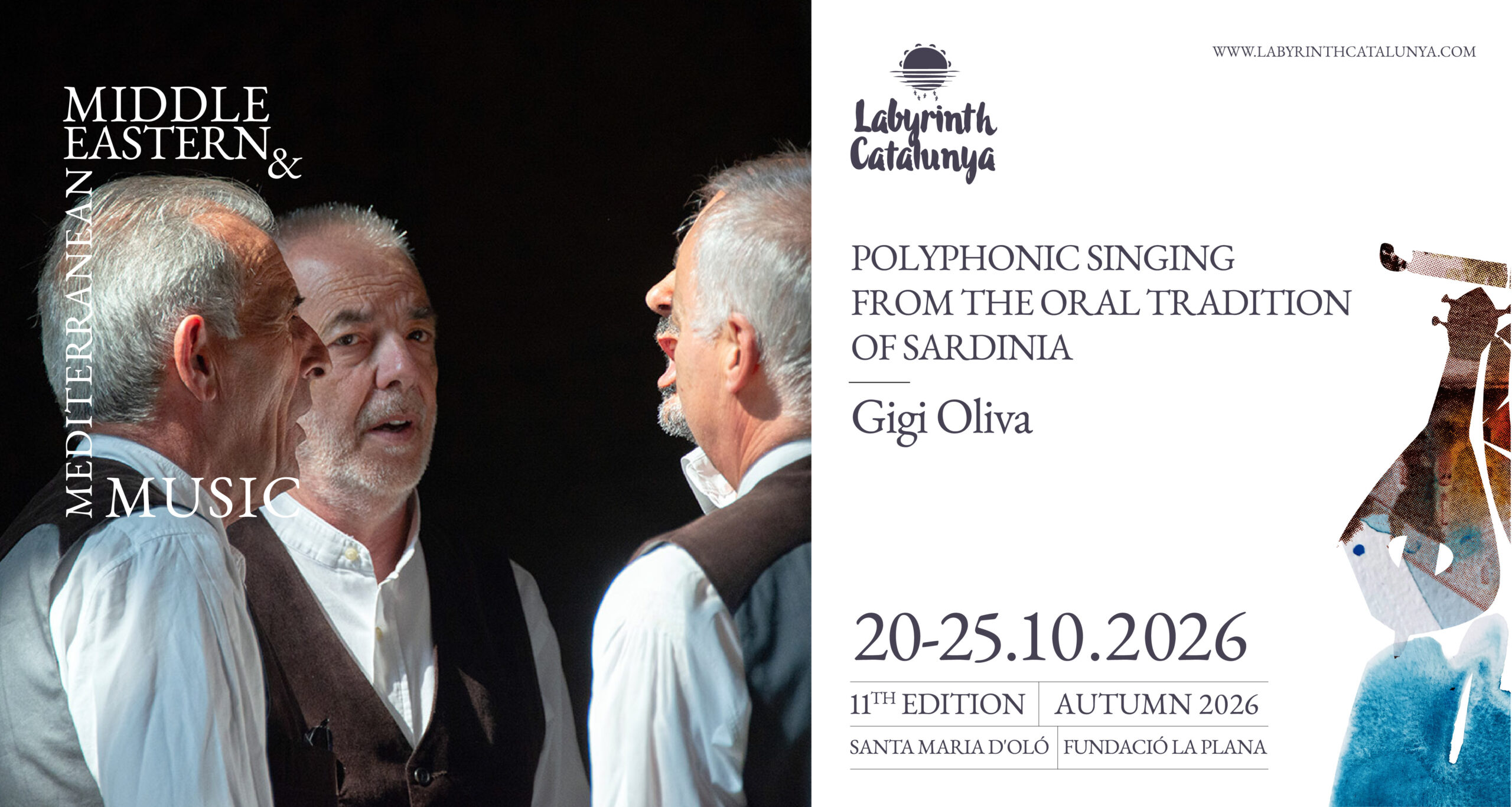
GIGI OLIVA: POLYPHONIC SINGING: FROM THE ORAL TRADITION OF SARDINIA
Thanks in part to its island geography, Sardinia has preserved a rich heritage of orally transmitted music. Even today, in many communities across the island, centuries-old traditions continue to resonate — evolving naturally through the process of oral transmission.
This workshop focuses specifically on multipart vocal singing, a practice of great interest among European ethnomusicologists. As ethnomusicologist Pietro Sassu noted, vocal polyphony stands out as one of the most remarkable expressions of Sardinian music for its richness and stylistic variety. Multipart singing is so widespread that in many areas it appears to be the only form of unaccompanied song — purely monophonic forms having largely disappeared from public performance contexts (Macchiarella, 2005).
Every village in Sardinia has its own repertoire and its own name for this practice: cuncordu, taja, cuntzertu, cuntrau, traggiu, and more. Its origins are difficult to date precisely, but indirect evidence links it to the 16th century, when Franciscan and Jesuit monks introduced the practice of falsobordone following the Council of Trent — though this may well have taken root in an already existing choral tradition (Macchiarella, 2012).
The workshop is primarily practical and will guide participants through:
- Brief historical and geographical context
- Introduction to melodic, harmonic, and timbral analysis
- Performance contexts
- Voice leading: individual creativity, improvisation, and dialogue between singers
- Study of representative pieces
Open to all, no prior musical training required, only curiosity and willingness to engage.
